
Welcome to the future of interaction. If you’ve ever felt like your AI tool is a brilliant but stubborn intern who just isn’t “getting it,” you’re not alone. The secret isn’t in the model’s intelligence; it’s in your translation. Welcome to our AI Prompt Engineering Guide, where we move beyond simple questions and start programming with English.
In 2025, prompt engineering has evolved from a niche skill for tech enthusiasts into a fundamental literacy for everyone. We have moved past simple chatbots to Agentic Workflows—systems that can plan, reason, and execute complex tasks. It is no longer just about asking ChatGPT or Gemini to “write a poem.” It is about structuring logic, defining constraints, and collaborating with a non-human intelligence to achieve results that feel disturbingly human.
Whether you are a developer building autonomous agents, a writer crafting a novel, or a curious explorer, this guide will walk you through the frameworks, mindset shifts, and advanced techniques you need to master.
The Mindset Shift: From Magic Box to Co-Pilot
The biggest mistake beginners make is treating AI like a search engine. They type a query and expect a perfect answer. But Large Language Models (LLMs) are not search engines; they are prediction engines. They are predicting the next most likely word based on the context you provide.
To get better results, you need to shift your mindset. You are not “searching” for an answer; you are steering a conversation. You are the captain, and the prompt is your steering wheel. If you steer vaguely, you drift. If you steer with precision, you arrive exactly where you intended.
This AI Prompt Engineering Guide is built on the principle that context is king. An LLM without context is like a genius actor without a script—they might improvise something interesting, but it probably won’t be the movie you wanted to make.

The Anatomy of a Perfect Prompt: The CRISP Framework
In 2025, we don’t just “wing it.” We use frameworks. One of the most effective and easy-to-remember frameworks for writing robust prompts is CRISP.
C – Context
Who is the AI? What is the background?
- Bad: “Write an email about the delay.”
- Good: “You are a customer service manager at a high-end tech firm. We are facing a 2-week shipping delay due to supply chain issues.”
R – Role
Assign a persona. This helps the AI adopt the correct tone, vocabulary, and perspective.
- Instruction: “Act as a senior Python developer” or “Act as an empathetic therapist.”
I – Instruction
What exactly do you want the AI to do? Use active verbs.
- Instruction: “Analyze the following data,” “Draft a blog post,” “Refactor this code.”
S – Specification
What format should the output take? This is where you avoid walls of text.
- Instruction: “Output the result as a Markdown table,” “Keep it under 200 words,” “Use bullet points.”
P – Parameters (or Constraints)
What should the AI not do?
- Instruction: “Do not use technical jargon,” “Avoid passive voice,” “Focus only on organic growth strategies.”
The Evolution of a Prompt: From Basic to Pro
To truly understand the power of engineering, let’s look at how a prompt evolves. We will take a single task and refine it through three levels of complexity.
Case Study 1: Marketing Content
Level 1: The Basic Prompt (The “Search Engine” Approach)
“Write a blog post about coffee.”
- Result: A generic, wikipedia-style article about the history of coffee, likely starting with “Coffee is a popular beverage…” It has no voice, no target audience, and no strategic value.
Level 2: The Intermediate Prompt (Adding Context)
“Write a blog post about the benefits of cold brew coffee. Make it sound professional and include a recipe at the end.”
- Result: Better. It focuses on a specific sub-topic (cold brew) and includes a recipe. However, it might still sound robotic or like a high-school essay.
Level 3: The Advanced 2025 Prompt (CRISP + Persona)
“You are a hip, specialty coffee roaster running a blog for coffee enthusiasts (Role). Write a 600-word article titled ‘Why Cold Brew is the Champagne of Coffees’ (Instruction).
Context: Focus on the chemical difference in acidity between hot and cold extraction. Target Audience: Millennials who brew at home but want café quality. Tone: Witty, energetic, and slightly snobbish but accessible. Format: Use short paragraphs, H2 headers for readability, and end with a ‘Pro Tip’ box in Markdown. Constraints: Do not use the word ‘delicious’ more than once. Avoid generic phrases like ‘kickstart your day’.”
- Result: A highly engaging, brand-specific piece of content that discusses acidity levels, appeals directly to the target demographic, and follows a strict formatting guide ready for publishing.
Case Study 2: Coding & Development
Level 1: The Basic Prompt
“Fix this Python code.”
- Result: The AI will likely fix the syntax error but might ignore logical bugs, efficiency issues, or code style violations.
Level 2: The Intermediate Prompt
“Find the bug in this Python function and rewrite it to be faster.”
- Result: The AI optimizes the code. However, it might change variable names you didn’t want changed or use a library you don’t have installed.
Level 3: The Advanced 2025 Prompt (Chain-of-Thought + Constraints)
“Act as a Senior Backend Engineer (Role). Review the following Python function for performance bottlenecks and edge cases (Context).
Instructions:
- First, think step-by-step and list the potential time complexity issues in the current implementation.
- Explain why the current approach is inefficient for large datasets.
- Provide a refactored version using the
pandaslibrary.- Ensure the new code handles empty lists and
Nonevalues gracefully.Output Format:
- Section 1: Analysis (Bullet points)
- Section 2: Refactored Code (Python block)
- Section 3: Unit Test examples”
- Result: You get a mini-technical design document. The “step-by-step” instruction forces the AI to reason before it writes code, significantly reducing logical errors.
Case Study 3: Data Analysis & Business Intelligence
Level 1: The Basic Prompt
“Analyze this sales data.”
- Result: The AI provides a generic summary stating “sales went up in Q4” without any actionable insight or deep dive into why.
Level 2: The Intermediate Prompt
“Look at this CSV data and tell me which product sold the best. Also, make a chart.”
- Result: It identifies the top product and might generate a basic bar chart code snippet, but lacks business context.
Level 3: The Advanced 2025 Prompt (Role + Hypothesis Testing)
“Act as a Chief Financial Officer (CFO) for a SaaS company. We are looking for churn patterns (Context).
Data Context: The attached CSV contains customer subscription start dates, cancellation dates, and monthly recurring revenue (MRR). Instructions:
- Calculate the average customer lifetime value (LTV).
- Identify if there is a correlation between low MRR tiers and high churn rates.
- Suggest 3 strategic pricing changes based on this data. Output: A board-meeting ready summary in Markdown, followed by the Python code used for the analysis.”
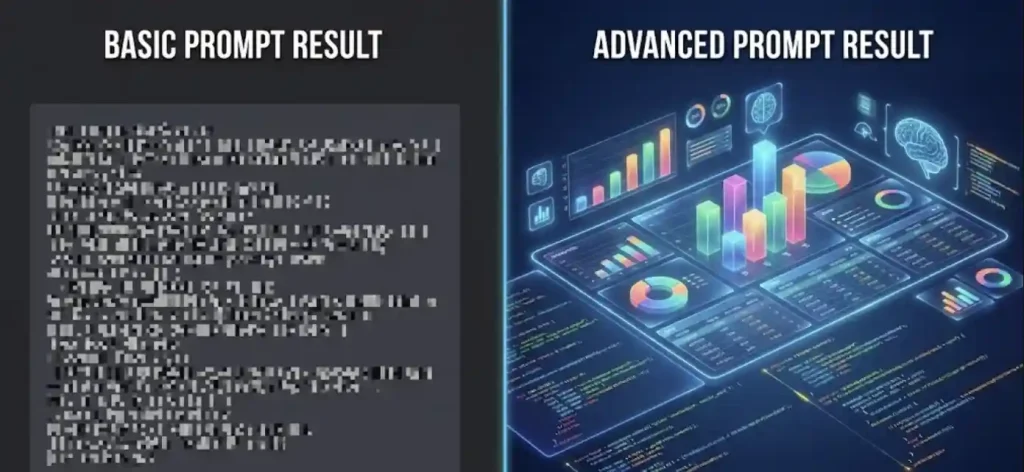
- Result: The AI acts as a strategic partner, not just a calculator. It connects data points to business strategy, offering specific actionable advice on pricing tiers.
Advanced Techniques for 2025
Once you have the basics down, it’s time to level up. The most powerful results come from advanced techniques that guide the model’s reasoning process.
1. Chain-of-Thought (CoT) Prompting
This is the single most effective way to improve logic and math capabilities. Instead of asking for the answer, you ask the model to “think step-by-step.”
- Standard Prompt: “If I have 5 apples, eat 2, and buy 3 more, how many do I have?”
- CoT Prompt: “If I have 5 apples, eat 2, and buy 3 more, how many do I have? Let’s think step by step.“
By forcing the model to articulate its steps, it generates its own context for the final answer, drastically reducing errors. In 2025, this is essential for complex reasoning tasks like legal analysis or debugging.
2. Prompt Chaining (The Agentic Approach)
In 2025, we don’t try to fit everything into one prompt. We use Prompt Chaining. This breaks a complex task into a series of smaller, manageable prompts.
- Step 1: “Generate 10 headline ideas for a fitness app.” (Review and pick the best one).
- Step 2: “Using headline #3, create a detailed outline for a landing page.”
- Step 3: “Now, write the Hero Section copy based on that outline. Focus on the benefit of ‘saving time’.”
This prevents the AI from getting “distracted” by too many instructions at once and ensures high quality at every stage.
3. The “Ask Me Questions” Technique (Flipped Interaction)
Sometimes, you don’t know what information the AI needs. Flip the script and let the AI interview you.
- Prompt: “I want to build a marketing plan for my new bakery. I don’t know where to start. Ask me 5 questions about my business, target audience, and budget. Wait for my answers before generating the plan.”
This guarantees the final output is tailored to your specific situation, rather than a generic template.
4. Few-Shot Prompting
Don’t just tell; show. Providing examples (shots) helps the AI understand the pattern you want to match. This is faster than writing long instructions.
- Prompt: “Convert these sentences into a pirate style. Input: Hello, how are you? -> Output: Ahoy matey, how be ye fairing? Input: Where is the bathroom? -> Output: Where be the head? Input: I am hungry. -> Output: …”
5. Delimiters are Your Friends
In complex prompts, use delimiters to separate instructions from the content. It stops the AI from getting confused about where the instructions end and the text begins. Common delimiters include triple quotes ("""), triple backticks (```), or XML tags (<text>, </text>).
- Example: “Summarize the text delimited by triple quotes below. “”” [Insert long text here] “”” “
→ (Insert Image Here — Prompt: ‘Futuristic holographic interface displaying complex code structures and logical flowcharts, floating in a dark void, cyberpunk aesthetic, neon green and purple’)
Mastering Multimodal Prompts (Images & Vision)
In 2025, prompts aren’t just text. We are prompting for images, video, and audio. The formula for a perfect image prompt is distinct from text.
The Formula: Subject + Action + Context + Art Style + Lighting/Camera
- Bad Image Prompt: “A cat.”
- Good Image Prompt: “A fluffy Siamese cat (Subject) chasing a laser pointer (Action) in a cozy, cluttered living room (Context), drawn in a Ghibli-inspired anime style (Art Style), with warm afternoon sun streaming through the window (Lighting).”
When using AI to analyze images (Vision), be specific about what you want it to look at:
- “Analyze this chart. Focus specifically on the Q3 dip and explain potential causes based on standard retail trends.”
Common Mistakes to Avoid
Even with this AI Prompt Engineering Guide, it’s easy to fall into traps. Here are the most common pitfalls we see:
- The “Fluffy” Trap: Using polite filler words like “Please,” “If you don’t mind,” or “I was wondering if…” You don’t need to be rude, but be direct. The AI doesn’t have feelings (yet), and extra words dilute the token importance of your actual instructions.
- Overloading: Trying to do too much in one prompt. If you want a summary, a translation, and a sentiment analysis, break it into three separate steps or a chained prompt.
- Vague Constraints: Saying “Keep it short” is subjective. Saying “Keep it under 280 characters” is objective.
- Negative Constraints Only: Telling an AI what not to do is often harder for it to process than telling it what to do. Instead of “Don’t write long sentences,” try “Use short, punchy sentences under 15 words.”
The Iterative Process: Refine, Don’t Reject
If the first result isn’t perfect, don’t blame the AI. Look at your prompt. Did you specify the tone? Did you give enough context?
Prompt engineering is an iterative process. You draft, you test, you refine. You might need to add a constraint (“No, don’t use emojis”) or clarify the role (“Actually, sound more professional”).
Consider using tools or libraries like PromptingGuide.ai to stay updated on the latest research and techniques. The field changes fast, and what worked in 2024 might be obsolete by the end of 2025.

Frequently Asked Questions (Q&A)
Q1: Will prompt engineering be replaced by smarter AI models? In 2025, AI models are indeed smarter, but they still lack mind-reading capabilities. While basic prompting is becoming automated, strategic prompt engineering—defining complex logic and constraints—remains a critical skill. Think of it less as “learning to Google” and more as “learning to manage a team.”
Q2: What is the difference between Zero-shot and Few-shot prompting? Zero-shot is when you ask the AI to do something without giving examples (e.g., “Translate this”). Few-shot is when you provide 2-3 examples of the input and desired output before asking it to perform the task. Few-shot almost always yields higher quality results for specific formats.
Q3: How do I stop the AI from “hallucinating” (making things up)? You can reduce hallucinations by adding a specific instruction: “If you do not know the answer based on the provided text, state that you do not know. Do not invent information.” Also, providing reference text (Grounding) heavily reduces fabrication.
Q4: Is there a universal “perfect prompt”? No. A prompt that works perfectly for GPT-4o might need tweaking for Claude 3.5 Sonnet or Gemini 1.5 Pro. Each model has slightly different “personalities” and training data biases. Testing your prompts across different models is a best practice.
Q5: Is my data safe when I put it into a prompt? Be cautious. Unless you are using an Enterprise version of an AI tool with explicit privacy guarantees, assume that your prompts might be used to train future models. Never put PII (Personally Identifiable Information), passwords, or proprietary trade secrets into a public AI interface.
Conclusion
Mastering this skill is like learning a new language—one that allows you to communicate with the sum of human knowledge. By applying the frameworks in this AI Prompt Engineering Guide, you stop being a user and start being a director.
The future belongs to those who can ask the right questions. So, open your favorite AI tool, take a deep breath, and start steering.
For more insights on the latest tech trends, don’t forget to check out our IT and Tech News category.

