
Let’s be real for a second: when ChatGPT and other generative tools first exploded onto the scene, a lot of freelancers panicked. I saw the forums lighting up with doom-and-gloom predictions—”Copywriting is dead,” “Coding is over,” “Why would anyone hire me now?” But while others were worrying about being replaced, I saw an opportunity. I realized that freelancing with AI wasn’t about letting a robot do my job; it was about giving myself a superpower.
Today, I’m going to walk you through exactly how I built a profitable business on Fiverr and Upwork by treating AI not as a replacement, but as the ultimate productivity booster.
My philosophy is simple: AI is the engine, but I am the driver. If you hand the steering wheel over to the robot completely, you’re going to crash. But if you steer it with expertise, you can drive faster than anyone else on the track.

The Mindset Shift: AI as Your Junior Assistant
The biggest mistake new freelancers make when freelancing with AI is copy-pasting. They grab a prompt, paste the output into a Word doc, and send it to the client. This is a recipe for disaster. Clients aren’t stupid; they know what “AI-speak” sounds like. It’s robotic, repetitive, and soulless.
To succeed, you have to shift your mindset. Treat AI as your junior assistant—the intern who does the heavy lifting, gathers the research, and sets up the framework. Your job, as the senior expert, is to polish, correct, and inject personality into that work.
By using this hybrid approach, I quadrupled my output without sacrificing quality. Where I used to write one article a day, I could now produce four high-quality pieces, all while charging premium rates because the final result was indistinguishable from human-only work.
Step 1: The “Hybrid” Workflow
Here is the exact workflow I use to deliver premium results on platforms like Upwork and Fiverr. This is the secret sauce to freelancing with AI successfully.
Phase A: Structure and Ideation
I never stare at a blank page anymore. I use AI to generate detailed outlines.
Let’s say a client wants a 2,000-word guide on “Sustainable Gardening.” I don’t ask the AI to “write the article.” I ask it to “create a comprehensive outline for an expert-level guide on sustainable gardening, focusing on soil health and water conservation.”
This gives me a roadmap. I can move sections around, delete the fluff, and add specific points that I know (from my own research) are trending.

Phase B: The “Rough Draft” Generation
Once the outline is solid, I generate the content section by section. Crucial Tip: Do not generate the whole thing at once. The AI loses focus. I feed it one H2 heading at a time.
This provides me with a “clay” block of text. It has the facts (mostly), but it lacks the soul.
Phase C: Heavy Human Editing (The Money Maker)
This is where the magic happens. This is why clients pay me. I go through the AI text and destroy it.
- I break up long sentences. AI loves run-on sentences; humans love punchy ones.
- I add anecdotes. AI doesn’t have a childhood or past experiences. I add “I remember when…” or “In my experience…” to ground the text in reality.
- I fact-check relentlessly. AI hallucinates. It will invent statistics. I verify every single claim and link out to real, authoritative sources.
Step 2: SEO Optimization & The “Undetectable” Standard
One of the biggest selling points in my gig is that my content is SEO-optimized and passes AI detection tests. When you are freelancing with AI, you cannot ignore SEO.
AI is great at stringing words together, but it is terrible at strategic keyword placement. It tends to “stuff” keywords awkwardly or miss the intent entirely.
I use tools like Yoast SEO or RankMath to ensure the structure is perfect. I manually weave in LSI (Latent Semantic Indexing) keywords that the AI missed. I check the readability score to ensure it’s not too academic or too simple.
Furthermore, because I rewrite so much of the content to add my own voice, the content naturally bypasses AI detectors. It flows better. It has rhythm. It creates a connection. That is the difference between a $5 gig and a premium service.

Step 3: Positioning Yourself on Fiverr & Upwork
Now that you have the skills, how do you sell them?
Honesty is the best policy, but you have to frame it correctly. On my profiles, I don’t hide that I use technology. I position myself as an “AI-Enhanced Creator.” Clients love efficiency. If they know you can deliver faster because of your tools, they are happy—as long as the quality is top-tier.
The Upwork Strategy
On Upwork, I bid on jobs that require high volume but high accuracy. In my cover letters, I emphasize that I use a “Human-in-the-Loop” workflow. I explain that while I utilize modern tools for research and structure, every sentence is manually vetted and polished by me.
The Fiverr Strategy
On Fiverr, your Gig image and description are everything. You need to look professional. You need to show that you understand the modern landscape.
When setting up your Gig, make sure your description highlights the benefits of your hybrid approach: Speed, Accuracy, SEO Optimization, and Human Creativity.
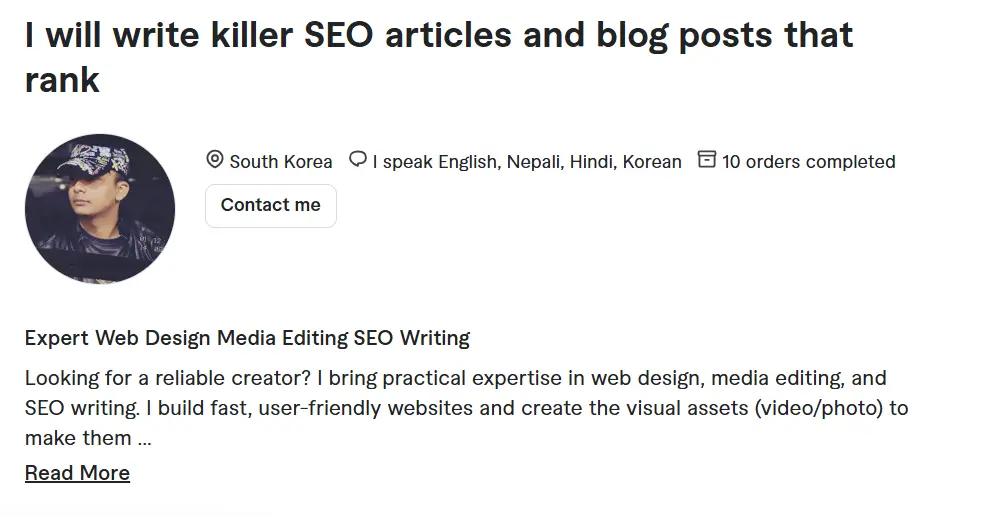
For a real-world example of how to structure a high-converting Gig that leverages this exact methodology, take a look at my own service here: Check out my Fiverr Gig here
Notice how the gig focuses on the result? The client gets a professional, polished, and ready-to-publish article. That is what they care about.
Step 4: Quality Control is Your Brand
If you are freelancing with AI, one slip-up can ruin your reputation. If a client finds a sentence that says “As an AI language model…” because you forgot to delete it, you are done. Game over.
I have a rigid checklist before I submit anything:
- Read Aloud: I read the entire piece out loud. If I stumble over a sentence, I rewrite it. AI text often looks good on screen but sounds clunky when spoken.
- The “So What?” Test: For every paragraph, I ask, “So what?” If the text is just fluff that doesn’t add value, I cut it. AI loves fluff. You need to be the butcher.
- Formatting: I use bolding, bullet points, and short paragraphs to make the content skimmable. AI tends to write walls of text.
Conclusion: Adapt or Get Left Behind
The freelancing landscape is changing. You can either complain about it, or you can grab a surfboard and ride the wave. Freelancing with AI has allowed me to scale my business in ways I never thought possible. It gave me my time back and allowed me to focus on the creative, strategic parts of work that I actually enjoy.
Remember, the goal isn’t to do less work; it’s to do more valuable work. By combining the speed of AI with the creativity and critical thinking of a human, you become unstoppable.
If you are looking for more guides on how to navigate the tech world and improve your digital skills, don’t forget to check out my other articles in the Tutorials Category.
Now, go out there, set up that profile, and start building your hybrid empire!