
A notification asking if you’ve died would look like a sick prank or a glitch. But in China, where millions of young professionals are crammed into solitary apartments, this question isn’t a threat. It’s a lifeline.
The name of the app is “Are You Dead?” (or Sileme in Mandarin). Out of nowhere, it rocketed to the top of the paid charts, raising the debate about isolation, safety, and what happens when our human connections start to fray. The name sounds like a dark joke, sure. But the problem it solves is a genuine: the fear of dying alone and nobody noticing.
Here is why this controversial piece of software is dominating tech conversations across Asia, and what it really says about our increasingly lonely lives.
A “Dead Man’s Switch” for the Digital Age
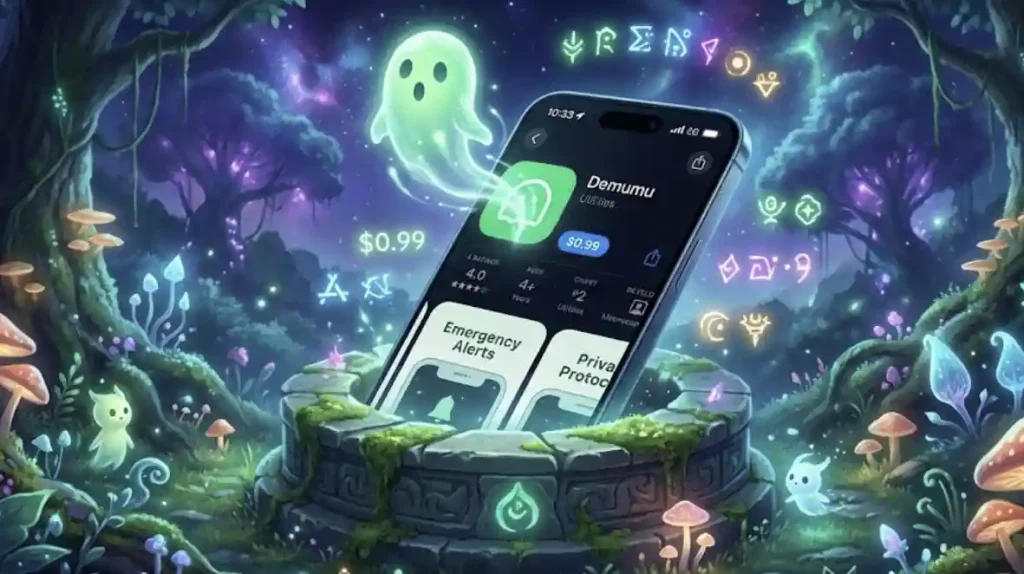
At its heart, the Are You Dead app China craze runs on a mechanism that is almost shockingly simple. It doesn’t use AI to track your health. It doesn’t ask for invasive biometric data. It’s just a classic “dead man’s switch.”
You set a timer for 24 or 48 hours, if you don’t open the app and tap the “check-in” button before the clock runs out, the system assumes the worst. It automatically sends a notification to your emergency contact, telling them you’ve gone silent.
That’s the whole pitch. No social feed, no badges to earn, no ads. Just a button that asks: Are you still here?
Internationally, people know it as Demumu. A trio of Gen Z creators built it remotely and slapped a modest 8 yuan price tag (about $1.15) on it, figuring it would remain a niche tool. They were wrong. Moonscape Technologies, the developers, found themselves sitting on a cultural powder keg as downloads surged by the thousands every single day.
Why “Are You Dead?”—The Name That Broke the Internet
To really get the virality, you have to understand the pun. In Chinese, Sileme (“Are you dead?”) sounds aggressively similar to Eleme (“Are you hungry?”), one of the country’s most famous food delivery giants.
It’s a bit of dark, biting humor that hits home for China’s “996” workers (9 a.m. to 9 p.m., 6 days a week). Young employees often joke that they barely survive the gap between food deliveries and sleep. The app’s name leans right into that exhaustion. It’s cynical, but it feels authentic to a generation that uses self-deprecation just to cope.
Traditional Chinese culture tends to be superstitious about death; mentioning it directly is often seen as inviting bad luck. Critics slammed the name as “ominous” and “cursed,” arguing that safety tech shouldn’t carry that kind of negative energy.
“It feels like a death notification rather than a safety tool,” one user commented on Weibo. “Why can’t it be called ‘Are You Safe?’ or ‘I’m Here’?”
The developers listened. After the explosion of interest—and the backlash that followed—they announced a rebrand for the global version: Demumu. It’s a softer, nonsensical name that strips away the morbid edge. But let’s be honest—would an app called “Daily Safety Check” have made international headlines? Doubtful. The shock value was the marketing strategy, whether they planned it or not.
The Solo Living Explosion and the “Loneliness Economy”
This didn’t happen in a vacuum. The Are You Dead app China phenomenon is the direct result of a massive demographic shift.
Look at the numbers: as of 2024, China has over 100 million single-person households. By 2030, that figure will likely swell to nearly 200 million. We are witnessing a generation of “empty nest youth”—young people moving to Tier-1 cities like Beijing, Shanghai, and Shenzhen for work, leaving their support networks hundreds of miles behind.
I’ve covered plenty of tech trends on Trick47.com, but few feel as poignant as the “Loneliness Economy.” Usually, that term brings to mind pet robots or single-booth karaoke bars. Demumu represents a darker, more pragmatic sector of this economy: Survival Tech.
For anyone living solo, loneliness is just the background noise. The real fear? Safety. Headlines across Asia are increasingly splattered with stories of kodokushi—lonely deaths—where people die in their apartments and aren’t found for weeks. We used to think of this as an ‘elderly problem.’ Not anymore. It has morphed into a genuine terror for young, burned-out professionals who are too isolated to be missed.
Li, a 28-year-old graphic designer in Shanghai, told local media she downloaded the app the second she saw it. “I live alone, I work from home, and I sometimes go days without speaking to anyone face-to-face,” she said. “If I slipped in the shower or choked on food, who would know? This app is cheaper than a security system and less invasive than a camera.”
Trusting Code Over Community
What makes this trend fascinating—and frankly, a little depressing—is what it says about our social fabric. In the past, if you missed work or didn’t leave your house for two days, a neighbor knocked on your door. A shopkeeper noticed.
Today, in our hyper-connected yet socially distant world, digital silence is normal. You can be online, doom-scrolling TikTok, appearing “active” digitally while being in physical danger. Users of the Are You Dead app China are essentially outsourcing the role of a concerned neighbor to a few lines of code.
There is a distinct “burstiness” to the user reviews I’ve read. Some are practical (“It’s just peace of mind”), while others are deeply emotional. One reviewer wrote, “I set the emergency contact to my email. I don’t have anyone else to tell.” That single sentence hits harder than any tech spec sheet ever could.
Is Demumu Effective, or Just “Security Theater”?
From a technical standpoint, Demumu is incredibly basic. Critics argue that an email notification is a weak safety net. Emails get buried in spam folders; they don’t carry the urgency of a ringing phone. If you are actually in trouble, will an email sent 48 hours later really save you?
Probably not.
But viewing this purely as a rescue tool misses the point. It’s a psychological salve. It gives users a sense of agency, a feeling that they’ve taken some action to protect themselves. For 8 yuan, you buy the assurance that the universe hasn’t completely forgotten you.
The developers aren’t stopping there, either. They are reportedly working on SMS integration and even linking with smart wearables to detect heart rates, which would transform this from a passive timer into an active monitor.
If you’re interested in how technology is adapting to these unique sociological needs, you can read more about the intersection of tech and solo living on major outlets like the BBC, which has been tracking the rise of safety apps in East Asia.
The Future of Solitary Safety
The success of the Are You Dead app China proves the tech industry has a blind spot. We spend billions developing AI that can write poetry or generate videos, yet we often ignore primal human needs: safety and belonging.
Demumu is a crude solution to a complex problem, but it works because it’s honest. It acknowledges that for millions of people, the scariest thing isn’t a cyberattack or a lost password—it’s the silence of an empty room.
As this app expands globally under the name Demumu, expect copycats. We might see “Check-In” features baked right into iOS or Android, or perhaps dating apps and social networks will start offering “Safety Monitor” add-ons.
Until then, for the millions of people living alone in the concrete jungles of the world, checking a box that says “I am alive” might just be the most important click of their day.
What’s your take? Is this app a morbid necessity or a sad reflection of where society is headed? Drop a comment below. Stay safe, and keep checking in.

