
Let’s be real for a second. If you’re a blogger, a marketer, or anyone who has spent the last decade painstakingly optimizing content for Google, the last year has felt… weird. That sinking feeling you get when you check your analytics? You’re not imagining it. We’re all asking the same big, scary question: “Will AI kill my search engine traffic?” The AI impact on search traffic isn’t just a future problem; it’s happening right now.
I’ve been in this game for a long time. I’ve survived algorithm updates, from Panda and Penguin to mobile-first indexing. Each one required a pivot, a change in strategy. But this, this feels different. This feels like the game board itself is being flipped over.
For years, the goal was simple: rank #1 on the SERP (Search Engine Results Page). That blue link was prime real estate. But now, generative AI features, like Google’s “AI Overviews,” are setting up shop above that prime real estate, answering the user’s query before they ever even see our links.
So, is it time to panic? Is SEO dead?
No. But it is transforming. The panic is real, but the opportunity is, too. The age of SEO is evolving into the age of AIO. And if you don’t learn the new rules, you’re going to be left behind.
The “Zero-Click” Apocalypse: What We’re Really Seeing
The core of the AI impact on search traffic is a “zero-click” problem.
Users ask Google a question, like “How do I fix a leaky faucet?” Instead of scrolling through 10 blue links (including my beautifully written, perfectly optimized DIY article), they get a neat, summarized, step-by-step answer right at the top, courtesy of AI.
The user gets their answer. Google fulfills its mission. And my website? It gets… nothing. No click, no ad revenue, no new email subscriber.
And this isn’t just a theory. Publishers and SEO experts are already reporting grim numbers. For many “informational” queries (the “how-to” and “what-is” content that forms the backbone of many blogs), click-through rates (CTR) are plummeting. Some studies have shown traffic drops of 20%, 40%, or even more for pages that used to be top performers.
This is the new reality of the AI impact on search traffic. The AI is effectively reading all our articles for the user and becoming the single source of information.
So, if our content is just being used as raw material for the AI’s summary, what’s the point?
SEO Isn’t Dead, It’s Just Evolving into a New Role
Okay, deep breath. “Kill” is a strong word. SEO isn’t dead, any more than radio was “killed” by television. It’s being forced to change its job.
The fundamentals of SEO—understanding user intent, creating high-quality content, building authority—are still the foundation. You can’t have good AIO without good SEO. But the goal has changed.
For a decade, our target audience was a human being scanning a list of links. Now, we have two audiences:
- The Human User (who might still scroll past the AI to find an in-depth source).
- The AI Model (who is scanning our content to find the most accurate, citable facts).
This is where AIO comes in.
Meet AIO: The New Playbook for an AI-First World
AIO stands for AI Optimization (or sometimes Answer Engine Optimization). It’s a new set of strategies designed to ensure that your content is the one the AI chooses to learn from and, most importantly, cite as its source.
The new currency of search isn’t just the click. It’s the citation.
If Google’s AI Overview answers a question and your website is listed as the source, that’s the new #1. It builds immense brand authority and, in many cases, will still capture the “power users” who want to click through for more detail.
So, What’s the Real Difference? SEO vs. AIO
Let’s break it down simply.
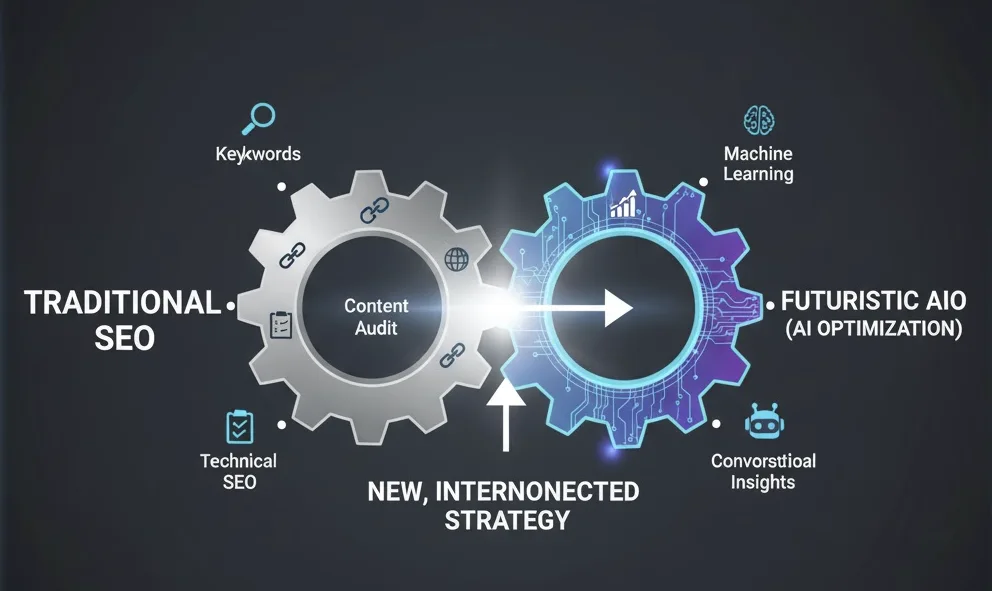
- Traditional SEO (Search Engine Optimization):
- Goal: Rank #1. Get the human to click your link.
- Tactics: Keyword density, meta descriptions, backlinks, page speed.
- Metric: Click-Through Rate (CTR) & Traffic.
- AIO (AI Optimization):
- Goal: Be the #1 source for the AI. Get your content featured and cited in the AI-generated answer.
- Tactics: Structured data, clear Q&A formatting, provable authority (E-E-A-T), and conversational language.
- Metric: Citation Rate & Brand Authority.
The AI impact on search traffic is forcing us to stop optimizing for “keywords” and start optimizing for “answers.”
How Do I Actually Do AIO? A 4-Step Guide
This is the part that matters. How do we adapt? Here is the new AIO playbook I am implementing on my own site.
1. Become an “Answer Engine,” Not Just a Blog AI models are looking for the most correct, concise answer. They don’t have time for your long-winded, personal story in the intro. (Ouch, I know. I love those, too.)
- Action: Structure your articles with clear questions in your subheadings (H2s, H3s). Answer the question immediately and concisely in the first paragraph below it. Use bulleted and numbered lists relentlessly. You can elaborate and add personal flair after you’ve given the AI the clean data it wants.
2. Speak the AI’s Language with Structured Data This is the most important technical part of AIO. Structured Data (or Schema Markup) is hidden code on your website that explicitly tells AI what your content is. It’s like adding labels: “This is a ‘How-To’ guide,” “This is an ‘FAQ’ section,” “This person is the ‘Author’.”
- Action: Start using Schema markup for
Article,FAQPage,HowTo, andPerson(for author bios). This makes it incredibly easy for the AI to parse your content and see it as a credible, well-structured source.
3. Prove You’re the Expert (E-E-A-T on Steroids) Google has been pushing E-E-A-T (Experience, Expertise, Authoritativeness, Trustworthiness) for years. With AI, it’s 100x more important. The AI must trust its sources to avoid “hallucinating” or giving bad info.
- Action: Double down on your author bios. Link to your social profiles. Cite your sources with outbound links to other authoritative sites. Present original research or unique case studies. The more you can prove a real, expert human wrote your content, the more the AI will trust it. This is how you fight the AI impact on search traffic—by being more human.
4. Think in Questions, Not Just Keywords The way people use search is changing. They aren’t just typing “best laptop.” They’re asking the AI, “What is the best laptop for a college student under $1000 who majors in graphic design?”
- Action: Your content needs to answer these complex, long-tail conversational queries. Use “People Also Ask” sections on Google to find these questions and build entire articles around answering them in detail.
My Personal Game Plan: Don’t Panic, Adapt
So, am I scared about the AI impact on search traffic? Honestly, a little. It’s a huge shift. But I’m also excited. This is a chance to clean up our content, focus on real expertise, and build authority in a new way.
My plan is twofold:
- Go all-in on AIO: I’m auditing my most important articles right now to make them “AIO-friendly.” I’m adding FAQ sections, sharpening my answers, and implementing structured data.
- Diversify! This is the biggest lesson. We cannot be 100% reliant on Google for traffic. I’m putting more effort into my email list and social channels. The traffic I own is now more valuable than ever.
I’m also paying more attention to my site’s internal ecosystem. Connecting my content in a logical way helps both users and AI understand what my site is an expert on. This is true for all niches, whether you’re writing about AI or any other It and Technology news.

The Future: Clicks vs. Citations
We are at a turning point. The old model of “10 blue links” is dying, and the AI impact on search traffic is the primary cause.
Our obsession with “traffic” as a single metric is going to have to change. We need to start tracking “citations,” “brand mentions,” and “authority” as key performance indicators. According. to a deep-dive study by Semrush, the future of search is a complex blend, and those who adapt will win. You can read more about their findings on how AI search is changing traffic.
The future of blogging isn’t about beating the AI. It’s about feeding the AI. It’s about creating content so good, so accurate, and so authoritative that the AI has no choice but to quote you.
So no, AI won’t “kill” search traffic. But it will absolutely kill the traffic of anyone who refuses to adapt.
Don’t be a dinosaur. Evolve. Start your AIO journey today.

